Showing posts with label SCUBA. Show all posts

Friday, October 31, 2008

Lost and found

Two 19th century shipwrecks found in Lake Erie

Friday,  October 31, 2008 10:59 AM

VERMILION, Ohio (AP) - Two 19th century shipwrecks have been found at the bottom of Lake Erie. Explorers say they believe the first wreckage belongs to the Riverside, a 133-foot, two-masted schooner built in 1870 in Oswego, N.Y., that was lost Oct. 13, 1893, about 25 miles north of Cleveland.

A second schooner also was found. Dive team member Dave VanZandt says said it could be the Plymouth, a 101-foot schooner built in 1847 in Huron, Ohio, that sank June 22, 1852, about 25 miles north of Lorain.

Investigators will try to confirm the names by looking for a number assigned by the government and carved into a midship beam.

The discovery by the Cleveland Underwater Explorers was announced Thursday in conjunction with the Great Lakes Historical Society in Vermilion.

Monday, September 29, 2008

I joke a lot about...

SCUBA diving not being a hobby but like a lifestyle, or better yet, like an illness.  More and more its become a true statement at least for me and the crew I normally dive with.  

From my experience, there's a paradigm shift when you catch the bug.  And, when I say "catch the bug", I'm not talking about your "once every two-three year resort" diving bug; I'm envisioning the "once to several times a week, I'll dive anything at least once" fever.  When this "infected" diver passes by a body of water, he wonders if it's dive worthy.  Free weekends at home become less and less; Vacation plans involves some body of water; gift he gives and receives is usually dive (or water) related.

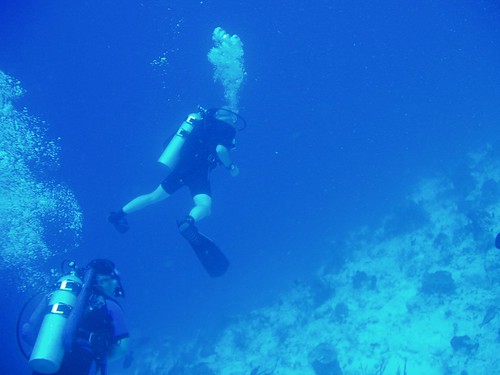
Here's an illustration.  Below is a picture of me w/ The Fog in Cozumel, just a couple of hours before his wedding.  The photograph was taken by head usher, Silverman.  And, Yes.  We all made it to the wedding on time, just barely.

Something Old:
  Tusa Fins

Something New:
  Diving Palancar Reef

Something Borrowed: 
  The AL 80 on his back

Something blue:
  The Water All Around.

If you're ever interested in getting this sick, let me know...

Technorati Tags:

Thursday, September 25, 2008

In need of a new SCUBA goal.

I'm now on the hunt for a new SCUBA goal. 

Slowly but surely, over the past several years, I've been continuing my own personal dive education.  During this time, I've helped many individuals attain their open water and up certification.  Over the past three years, I think I've been Divemaster or was an Assistant Instructor for over 150 divers. 

Some people may think this would get old, but I don't.  I believe it's vital to review basic open water skills until it becomes natural. 

[[One of the many important skill I like to harp on with any student is buoyancy control.  It truly does make for a good dive experience as well as allows for better air consumption and environmental conservation.  The thing is with this skill is it only come with diving experience.  So, you new divers, get out there, get wet and blow some bubbles. Anyway, I digress.  ]]

I guess what I was trying to say is that by basically being an SCUBA Instructor's apprentice, I get more of a chance to work on the basics and prepare myself for more difficult dives.

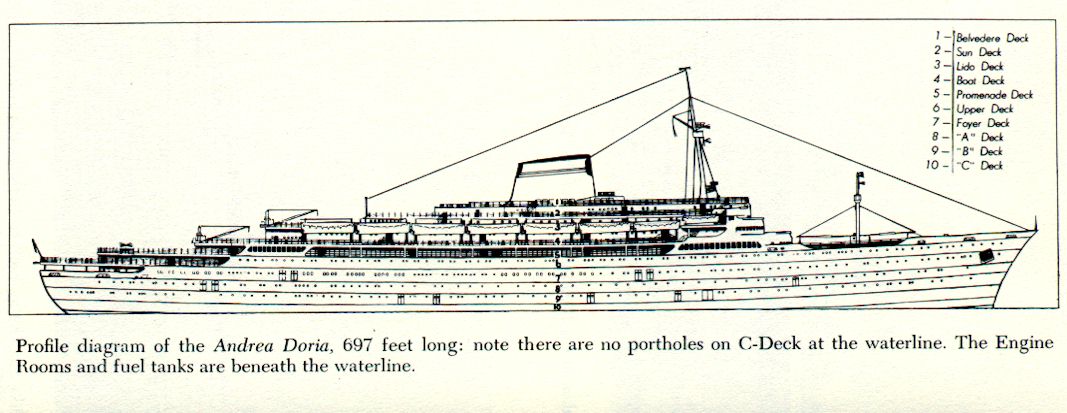
Until recently one of my personal SCUBA goals *was* to visit the Andrea Doria, a wreck site known as the "Mount Everest" of Scuba Diving. 

For those of you who don't know, the Andrea Doria was an Italian Passenger ship that collided with a freighter and sunk in 1956 off the coast of Nantucket.  For the longest time it was a frequent destination for treasure hunters and historians alike.  However, due to the conditions of the water in which the Andrea Doria finally rests, a number of divers have lost their lives at this site.

From my most recent research of the dive site, the ship has been collapsing more and more on to itself and is deteriorating to the point where diving the wreck is almost pointless and not worth the risk.  Why?  First of all, the minimum depth is now 190' and can go down to the sea floor at 240'.  Add to this the fact that there is a strong current that rips through the area and the heavy sediments can quickly make the dive a zero-visibility dive. 

Sigh...  this just doesn't sound fun.

I could give much more information of the Andrea Doria, but anyone interested could do a search on google or check the wiki on it....  but my point it that if I'm going to do something personally "remarkable", it needs to be worthwhile.

So, if anyone is reading this and has any thoughts, please let me know.

Wednesday, September 17, 2008

Another recall from Aqua Lung

25,000 Apeks second stage regulators are being recalled because the diaphragm cover can be missing.  This is bad.

Check out this link: http://tinyurl.com/4mqgdw

and http://www.aqualung.com/us/content/view/285/

Technorati Tags:

Thursday, September 11, 2008

Aqua Lung announced recall yesterday!

About 6,000 Titan DIN 1st Stage scuba regulators and Titan/Conshelf DIN scuba adaptors, made in France by Aqua Lung USA are being recalled.

Apparently, the over-tightening of the DIN retainer during installation can cause it to break and the regulator can detach from the scuba cylinder.  This, obvious, can pose a drowning hazard.

The company has received one report of a DIN retainer breaking under pressure. No injuries have been reported.

The recalled regulators have serial numbers lower than 6062501 stamped on the side of the body. The recalled adaptors are marked "300 BAR MAX" on the side. The recalled products were sold at authorized Aqua Lung dealers nationwide from January 1997 through this month. Details at 877-253-3483.

US Consumer Product Safety Commission Site:

http://www.cpsc.gov/CPSCPUB/PREREL/prhtml08/08393.html

Sunday, September 7, 2008

Free diving during your SIT?

[This was posted a long long time ago]

It was a beautiful night, Sher and I were sitting around enjoying a couple of beers...  when all of a sudden our conversation turned totally romantic and went down the road of SCUBA and the bends. 

The question is, can one get bent while free diving, during their surface interval time?  I'm thinking that yes it's quite possible.

For you recreational SCUBA divers out there, you know that you should do a three minute "safety stop" at around 15 feet prior to surfacing at the end of your dive. *

For you non-divers, this practice adds an additional margin of safety (hence it's name), by allowing more inert gas to escape while they are compressed before breaking the surfaces which is at 1 atm. 

Either way, that safety is a self-imposed "decompression" stop done during a no-stop dive.   However, regardless of whether a diver chooses to do a safety stop or not, one must look at the surface interval time as the final decompression stop of the dive.  Once at the surface, the diver is no longer breathing compressed air and by normal breathing will eventually off gas saturated nitrogen. 


As an FYI, The YSCUBA and PADI programs both agree that 12 hours is the acceptable time for the body to return to it's normal, atmospheric, levels of gas saturation after a dive.

So, now, throw in free diving between SCUBA dives. 

Free diving is breath-holding diving.  So at depth, you're not loading any more nitrogen; however you're no longer allowing nitrogen to escape.  Additionally, if your surface time between free dives is low, there's definitely little off gassing being done. These simple facts alone mess up decompression calculations, if a diver is using dive tables. 

One last thought, when one free dives down to depths greater than 33 feet, there is further recompressing of inert gas bubbles at depth and ascending again at a rate more that suggested when SCUBA diving.  One would think this is bad.

So, in conclusion I would have to say it would be best to avoid free diving during your SCUBA dives and if one would want to snorkel, they should stay at the surface.

Tuesday, August 19, 2008

RGBM: A Brief Overview

[This is a re-post of a blog entry I made on August 1, 2005, over 3 years ago... wow.]

More dive computers are incorporating the Wienke Reduced Gradient Bubble Model (RGBM) Algorithm.  What is it and is it worthwhile for recreational divers? 

New research concerning decompression sickness (DCS) are finding if a diver adds a deep stop and a slow ascent to the traditional 15 feet safety stop, a larger margin of safety is introduced against DCS .

Dr Bruce Weinke, a NAUI Instructor trainer developed the RGBM as the next evolution of diving models based on studies of bubbles and the it's effects under pressure.  He theorize, much like the governing of on ramp to highways with traffic lights, adding a deep stop at half your maximum depth helps bubbles dissolve back into tissue for release out through the lungs at a faster rate than the traditional three minute safety stop at 15 feet.

Counter intuitive, you think?  But yes... according to this theory, staying at depth longer can help reduce nitrogen content faster than traditional diving models.

  • In general, the model suggests the following:
    Stop for one full minute at 1/2 your maximum depth.
  • Execute a slow ascent (30 feet / minute) to 15 feet.
  • Perform 15 feet safety stop as normal.

Obviously, there's much more physics and decompression theory involved to help back these findings, however they aren't addressed here.  You may find more information online or in Dr Wienke's book, Reduced Gradient Bubble Model in Depth.

If wanting to integrate deep stops in your diving profile, one must consider the following:

  • All dives are decompression dives
  • There's a difference between mandatory deco stops and safety stops
  • All diving profiles are models, based on thoery.

So, is it worthwhile?  That's for you to decide. 

As I work through my diving education, I've learned it never hurts to be more informed.

[2008 Update:  We have integrated this as part of our diving training procedures and practices.]

Monday, August 18, 2008

Practice makes perfect.

[This is a re-post of a blog entry I made on February 27, 2005, slight changes, including an annotation.]

Picture from The only way to get better at anything is to practice, practice, and practice. This philosophy is universal, but here I’m talking about SCUBA diving, specifically your buoyancy.

One of the first skills we develop as divers is buoyancy control. Yet, there are so many certified divers out there who clearly have not mastered this basic however vital skill. Out of the many possible reasons for this, one stands out most: heavy weighting. Whether it is the excitement to get down quickly or just a misunderstanding of how weight plays a role in SCUBA diving.

Bottom line, too much weight is never a good thing.  Being overly weighted causes fatigue, higher air consumption rate and unnecessary safety risks.

Being negatively buoyant at surface will expedite your descent, but it will hamper your diving and your enjoyment. Divers with too much weight will require more air in their BC to achieve neutrally buoyancy. As a heavy weighted diver descend to depth, they will have a difficult time compensating to the change in pressure and will usually bounce up and down searching for that “neutral” sweet spot.

An initial test for proper weighting can be done at the surface. With your regulator in mouth completely deflate you BC, relax and begin to breathe slowly. When your lung capacity is full, your eyes should be at water level. If you sink with lungs full of air, you’ll need to remove some weight. Once you completely exhale, you should sink. If you do not sink, add more weight. This should give you a good start point.

(For you new divers, the most important word in that last paragraph is “relax”. When excited or put into a new environment, people tend to hold their breath and breathe shallow. Full lung capacity can make you anywhere between six(6) to 12 pound positively buoyant.)

The one thing to note is that the proper weighting for SCUBA diving is being able to hover at 15 feet with 500 psi in your tank and no air in your BC.[1] Aluminum tanks begin to be positively buoyant once capacity is less than 1500psi (this is also known as “corking”) and will affect your buoyancy. Consequently, this will require the need for additional weight to the amount found when testing your buoyancy at the surface with a full tank.

When returning from your dive, take special note of your buoyancy control to see if additional weight is needed.  The recording of this information should be a standard line item in your individual dive logs.

As you dive more and more you’ll get a better understanding of how much weight you specifically need to dive comfortably. As you change your equipment configuration (i.e. exposure suits, aluminum versus steel tanks, etc.) you should always test your buoyancy to insure proper weighting.

When teaching students we say, "add a knife to your equipment, check your buoyancy."  Though we say it jokingly, we're somewhat serious.

Thursday, August 14, 2008

So, you want to be a technical diver? Preface

If you are remotely aware of the sport of SCUBA diving, you are familiar with the image of people stuffed into wet suits, their face hidden behind a regulator/mask and a large amount of weight donned onto their back.

If you are a SCUBA diver, you know there's a love/hate relationship with your wetsuit, the mask is your window into a new world, the regulator provides you the air you need to survive and the hefty burden on your back becomes weightless once you descend into the water.

SCUBA diving is an enjoyable hobby.  It opens up a whole new world to explore and experience.  However just like every other sport, proper training, equipment and mentality is vital to keeping the sport safe for yourself and your dive buddy.

The first step in the world of diving, is an Open Water certification.  This life time certification allows you to dive within the recreational limits set by the World Recreational SCUBA Training Council.

The criteria which defines a Recreational SCUBA Dive (RSD) are as follows:

  1. The breathing gas is either compressed air, or an oxygen enriched air breathing mixes of 21-40% oxygen.
  2. Diving is always with a buddy, never solo.
  3. Diving Depth does not exceed 130 feet.
  4. Depth-Time profile does NOT require a mandatory decompression stop.
  5. No other specialized training beyond the basic open water is required.

Additionally, there are many speciality certifications designed to enhance a recreational SCUBA diver's experience.  These courses allow divers to gain more knowledge, better prepare them for different underwater environments, as well as encourages them to continue with the sport.  In actuality, these courses actually create better divers, because divers can't improve unless they are constantly practicing the skills that they've learned. 

So, what happens when you want to go to the next level?  What happens when you want to go deeper and/or longer?

It goes with out saying that advancing your dive education requires additional training;  however, additional factors also come into play when a diver wants to exceed the boundaries of  RSD.  These factors include changes or additions in regards to diving equipment, discipline, maturity and a realistic understanding of one's own personal limits. 
There is some debate on what constitutes a Technical Dive.  In general, the following types of dives or situation is universally accepted as a technical dive:

  1. Diving within an overhead environment
    1. cave diving
    2. wreck diving
    3. ice diving
  2. Diving to depths greater than 130 feet.
  3. Mixed gas diving >40% O2 (nitrox) or trimix.
  4. Diving with specialized equipment such as a O2 re-breather.
  5. Diving a depth-time profile require one or more mandatory decompression stop.

If any of diving scenarios peaks your interest, then maybe Technical diving is for you.   Over the next couple of weeks, I hope to outline all the different aspects of technical diving that I've been running into as I pursue my diving education.  The goal is to share my thoughts concerning the next level of this sport,  as well as simply journalizing my adventure.

Tuesday, August 5, 2008

Camp Ocean - Clean and Preserve with SCUBA

This is a project I've been thinking about for awhile. I stumbled across the Members Project website and thought I should take my idea to the next step.
Take a look and if you think it's a good idea, please nominate my project for consideration.

Tuesday, February 12, 2008

Update on my 2008 SCUBA Resolutions.

So back on January 6th, I made a small list of SCUBA resolutions for 2008.  One of the resolutions had me doing at least one dive for each month.  For those of you lacking in mathematics skills, that would have me do at least 12 dives this year.

By no means do I think that 12 dives/year is enough to keep a diver truly fresh with the sport.  However it's better than nothing.  However, if the past 3 years are any indications, the PUE will probably out do that by 10 fold.  Yet, I digress. 

The point of this post is to document my second dive this year.

I even have topside video.

The Dive Report

Dive: Circleville Twin Quarries
Date: 9 February 2008
Time: 9:45am EST
Air Temp: 34 degrees
Surface/Water Temp: 38 degrees
Exposure Protection:
  5mm full suit
  7mm boots, mittens, hood
Start/End PSI: 3100psi/2200psi
Weight: 12#
Max Depth: 20'
Dive Time: 17 minutes
Visibility: 8-10'  Very Cloudy
Experience:  The water was cold, however suit kept me pretty warm once I was acclimated to the temperature.  Experienced "ice cream" headache about 10 minutes into dive.  Swam the circuit, saw fish (blue gill, sm bass), also cleaned up around catamaran.
Areas of Improvement: Exposure protection.  Need a Dry Suit.

Monday, February 11, 2008

Megalodon Tooth

We're planning a trip to Cooper's River down in South Carolina sometime in the next couple of month.  Actually, I'm not planning the trip, our dive club is.

Unfortunately for me, I won't be able to get down there.  (Unless, we could coordinate this trip with a wedding the may have us already down their).  We'll see.

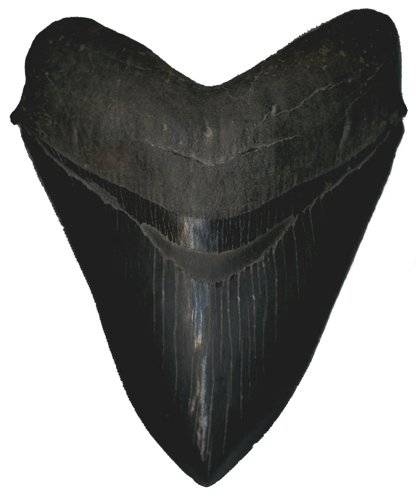
But, either way...  the only reason you diver Cooper River is for the hunt for Megalodon teeth.  What's a Megalodon?  It a HUGE prehistoric shark that lived between 16 to 1.5 million years ago.

Check out this video...  it's of a diver finding a tooth.  See if you could spot the tooth before the diver picks it up.  The video was shot in the beautiful waters of the Gulf of Mexico.

There's a big difference from this video and what you'd expect in Cooper's river. 

To start off, Cooper river is black water.  You'll need a dive light to see.  Your visibility is fixed to your dive light's range.  So, if you're achluophobic, lygophobia, myctophobic, nyctophobic, or  scotophobic, forget about this dive.  [[Unless you masochistic, then have at it]]

As the name of the location suggests, you are in a river, therefore your dealing with flowing water and current.  So definitely not for those with potamophobia.

There are eels and wildlife in the water.  Which has the makings for a great number of interesting head games.

And, lastly, the best part of the dive is the fact that large barges and boats are using the river for everyday traffic.  So, if your dive briefing says that you should stay deeper than 25' for at least 30 minutes, because a boat is expected by in 15 minutes, you'd best do so.

It's definitely a dive that can get your heart racing and I wouldn't say it's for everyone.  Would I do it again, most definitely...  but, I am sick in the head.

Pictured here to the left is something that The Fog happened across during our last trip to Cooper River.  Initially, we thought it was a femur from a human body.  However, Shane got it analyzed by someone at OSU and we have official word that it's a deer bone.  Whew!

Which is a good things, I don't like the thought of Shane and Jeanne having a pissed off ghost running around wanting his arm back.

Monday, January 21, 2008

The Riviera Maya

We were in Cozumel, for The Fog's and Martini Jeanne's wedding and I think if I had to recap, I should have pushed harder to get Shane into a Cenote Dive.

We kept saying, it shouldn't be that big of a deal to get back...  and, overall, I shouldn't be.  It's just that it would have been awesome to experience that dive while we were there, regardless.

Steve Simonsen is a photographer that has captured many good pictures of the Cenotes and has given SCUBA Diving magazine an opportunity to provide 'em out to readers for desktop backgrounds, etc.

Riviera Maya Wallpapers on SCUBA Diving Magazine's site.

SCUBA Diving Magazine's article on the Riviera Maya.

Yes, I've been dreaming of going to Mexico soon and seeing these sites again.

Check out this site for some details on deals, trips, hotels, etc.

Monday, January 14, 2008

Mount Storm Part 2

Saturday morning, we were able to sleep in to about 8:30am. 

[[That alone was worth the trip out of town.  Though two cute kids bouncing in your bed promptly at 6:30 screaming "Rise and Shine" can be considered adorable and endearing, it does tire your out quickly and makes for long days.
Oh, forgot to mention in my last post

Another consequence of selling out...  Free Starbucks Coffee]]


The girls got breakfast at the Regatta Club, while the boys shoved off for a one and half hour drive to Mount Storm.

The drive was good and easy.  We weren't in an rush and there was not big group that needed coordination; so, overall, the tempo was relaxing. 

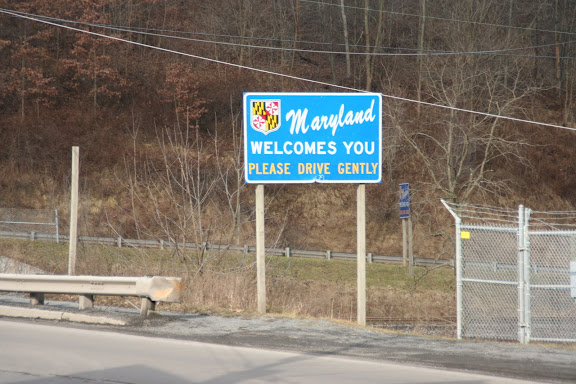
The was a point during the between Morgantown and Mount Storm we left West Virginia, went into Maryland, then back into West Virginia in less than 30 seconds.  Of course, I documented.


We arrived at the parking lot of Mount Storm at around 11:30.  And it was a balmy 36 degrees and dropping.  What's interesting about Mount Storm Diving is that the lake was built to cool down a coal burning power plant.  So, the water is generally warmer than normal.  Additionally, it's an altitude dive at 3,250 feet above sea level.

Dive: Mount Storm
Date: 12 January 2008
Time: 11:45am EST
Air Temp: 36 degrees
Surface/Water Temp: 56 degrees
Exposure Protection:
  5mm full suit
  7mm boots, mittens, hood
Start/End PSI: 2400psi/1100psi
Weight: 14#
Max Depth: 42'
Dive Time: 45 minutes
Visibility: 8-10'  Very Cloudy
Experience:  The water seemed warmer than diving Portage Quarry at similar depth in the middle of summer.  Lake is full of life, schools of catfish followed around.  Visited platform, rocky edge, motorcycle all while generally following underwater lines.

The rest of the trip was pretty uneventful.  Met back up with the girls, hit the hot tub and pool.  Did a warm shower, had dinner at an IHOP and came home back to reality.

If you're interested in seeing some land pictures, point your browser here.

Technorati Tags: ,,

Sunday, January 13, 2008

Mount Storm Part 1

To fulfill one of my 2008 SCUBA Resolutions and check off January from my "dive at least once each month" list, a group of us drove over to Mount Storm West Virginia for a nice mid January Dive.

We broke the trip into two legs, the first leg being a leisurely drive to Morgantown, West Virginia.  The thought behind this was to leave the CBUS after work on Friday, drive 3 hours to enjoy the town and night life in Morgantown.  Plus, this city is a wonderfully hilly town which was very inviting for a nice relaxing get away.  We ended up shacking up at the Water Front Place Hotel, which was definitely a plus compared to the alternative.

Our choice in Hotels...


The alternative...

We were called sell-outs for not going to the Mountaineer.  But, if you consider pillow top mattresses, fluffy pillows, indoor pool/hot tub, full service bar and room service selling out.  I'm all for it. 

Side note, ever seen the movie "Vacancy".  Yeah... enough said.

We ended up getting into Morgantown late, but the bar was still open, the conversation was good and the mood was relaxed.  What more can you ask for?

On Saturday, the boys would get up drive to Mount Storm, while the girls enjoyed a massage at the Hotel Spa and relax in the hot tub.

Sunday, January 6, 2008

2008 SCUBA Resolutions

Here's my short list of SCUBA goals for 2008.

Very doable, yes?  I think so.

Technorati Tags: ,